 The Bangladesh Travel Guide
Bangladesh : Religions
Islam, the state religion, is the faith of 88 percent of the population, almost all of whom adhere to the Sunni branch. Hindus make up most of the remainder, and the country has small communities of Buddhists, Christians, and animists.
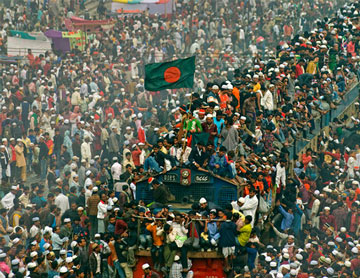
Bangladesh is one of the largest Muslim countries in the world. Most Bangladeshi Muslims are Sunnis, but there is a small Shia community. Among religious festivals of Muslims Eidul Fitr, Eidul Azha, Eiday Miladunnabi, Muharram etc. are prominent . The contention that Bengali Muslims are all descended from lower-caste Hindus who were converted to Islam is incorrect; a substantial proportion are descendants of the Muslims who reached the subcontinent from elsewhere.
Hinduism is professed by about 12 percent of the population. Durga Puja, Saraswati Puja, Kali Puja etc. are Hindu festivals. Hindus in Bangladesh are almost evenly distributed in all regions, with concentrations in Khulna, Jessore, Dinajpur, Faridpur, and Barisal.
Biharis, who are not ethnic Bangalees, are Urdu-speaking Muslim refugees from Bihar and other parts of northern India. They numbered about 1 million in 1971 but now had decreased to around 600,000. They once dominated the upper levels of the society. They sided with Pakistan during the 1971 war. Hundreds of thousands of Biharis were repatriated to Pakistan after the war.
Tribal race constitutes less than 1 percent of the total population. They live in the Chattogram Hills and in the regions of Mymensingh, Sylhet, and Rajshahi. The majority of the tribal population live in rural areas. They differ in their social organization, marriage customs, birth and death rites, food, and other social customs from the people of the rest of the country. They speak Tibeto-Burman languages. In the mid-1980s, the percentage distribution of tribal population by religion was Hindu 24, Buddhist 44, Christian 13, and others 19.
Major tribes are the Chakmas, Maghs (or Marmas), Tipras, Murangs, Kukis and Santals. The tribes tend to intermingle and could be distinguished from one another more by differences in their dialect, dress, and customs than by tribal cohesion. Only the Chakmas and Marmas display formal tribal organization. They are of mixed origin but reflect more Bengali influence than any other tribe. Unlike the other tribes, the Chakmas and Marmas generally live in the highland valleys. Most Chakmas are Buddhists, but some practice Hinduism or Animism.
The Santals live in the northwestern part of Bangladesh. They obey a set of religious beliefs closely similar to Hinduism. The Khasais live in Sylhet in the Khasia Hills near the border with Assam, and the Garo and Hajang in the northeastern part of the country.